Software Decision
data Strategic
enterprise
open sources
- Software Decision
- How to decise to move between open source vs commercial enterprise software
How to decise to move between open source vs commercial enterprise software
The decision to move between open source, commercial enterprise software, or a hybrid architecture is not determined by company size alone.
It is determined by:
- Business criticality
- Operational complexity
- Governance requirements
- Risk tolerance
- Total cost of ownership (TCO)
The Evolution Path
Most organizations naturally evolve through five phases.
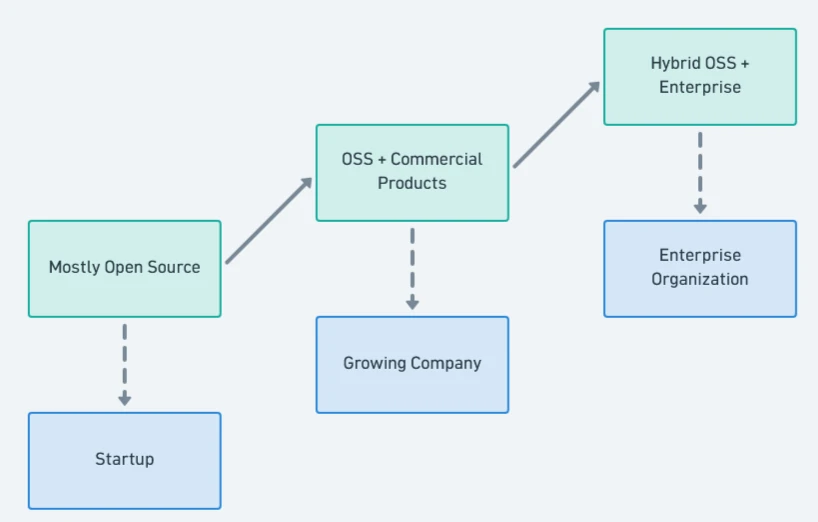
Very few mature companies use only enterprise software. Likewise, very few enterprises use only open source.
| Stage | Common Industry Practice | Supporting References |
|---|---|---|
| Startup → Mostly Open Source | Startups maximize agility and minimize licensing cost by adopting OSS infrastructure (Linux, PostgreSQL, Kubernetes, Prometheus, etc.). | CNCF Annual Survey 2023 & 2025, Linux Foundation Research, Gartner Hype Cycle for Open Source Software. CNCF Annual Survey 2023 |
| Growing Company → OSS + Commercial Products | Organizations begin purchasing commercial software when governance, support, compliance, and integration requirements exceed what internal teams can efficiently manage. | Gartner Hype Cycle for Open Source Software; Gartner Infrastructure Strategy. Hype Cycle for Open-Source Software, 2024 |
| Enterprise → Hybrid OSS + Enterprise | Large enterprises combine commercial business applications with open-source infrastructure because each addresses different concerns. | CNCF Annual Survey, Linux Foundation, Gartner Infrastructure Strategy. CNCF Annual Cloud Native Survey The infrastructure |
When Open Source Is Enough
Open source remains sufficient when all of these are true: Business complexity is low.
- Example:
- Single data warehouse
- Single production system
- Single ERP and CRM
- Compliance: minimal
- Security: managed internally
- No enterprise licenses required
Stage 1 — Mostly Open Source
- Primary objective:
Build products quickly with minimum cost. - Typical company:
- startup
- <100 employees
- engineering-driven
- few compliance requirements
- low IT budget
- Advantages:
- almost zero licensing cost
- highly customizable
- huge community
- avoids vendor lock-in
- Disadvantages:
- internal team maintains everything
- documentation quality varies
- upgrades require engineering effort
- enterprise support unavailable unless purchased
The Linux Foundation reports that cloud-native infrastructure is fundamentally built upon open-source technologies, while the CNCF survey consistently shows Kubernetes, Prometheus, and related OSS projects as the backbone of modern application platforms. CNCF Annual Cloud Native Survey The infrastructure, CNCF Annual Survey
Stage 2 — Open Source Begins to Reach Its Limits
Growth introduces complexity with typical indicators:
- Employee count: > 100
- Business systems: multi-division
- Engineering spends excessive time on:
- upgrades
- patching
- backups
- HA configuration
- disaster recovery
- security hardening
- identity integration
- The engineering team becomes a system integrator instead of delivering business value.
- Reason: Organizations purchase software where:
- SLA becomes important
- governance becomes mandatory
- vendor accountability is required
- compliance becomes regulated Supported by Gartner’s enterprise software research. Hype Cycle for Open-Source Software, 2024, Hype Cycle for Open-Source Software, 2025
Decision Trigger 1 — Costs
When Operating the platform costs more than licensing enterprise software. This is one of the strongest indicators.
In Example: > platform engineers costs > Enterprise managed platform.
The enterprise platform becomes economically preferable.
Decision Trigger 2 — Downtime
Business Downtime Becomes Expensive and larger than software licensing. Difference Bussiness case has difference tolerance value for downtime.
Decision Trigger 3 — Compliance
Compliance Requirements. Enterprise products often provide these capabilities out of the box with vendor support and certification.
In Example of need:
- audit logs
- encryption
- RBAC
- SSO
- MFA
- governance
- certification
Examples certification:
- ISO 27001
- SOC 2
- PCI DSS
- HIPAA
- GDPR
- regional privacy regulations
Decision Trigger 4 — Continuous operations
When the bussiness needs 24×7 Operations, some open source can absolutely support 24×7 systems. But the main question becomes Who supports it?.
For some Enterprise system, they have:
- Vendor
- 24×7 SLA
- Critical patch
- Emergency support
- Escalation engineers
This distinction becomes important for mission-critical systems.
Decision Trigger 5 — Integration
Integration Complexity. The challenge shifts from software installation to enterprise integration, governance, and lifecycle management.
Stage 3 — Enterprise Software Begins Appearing
Organizations typically adopt enterprise software where risk and complexity are highest. But only selected domains move to enterprise products and remains still using open source.
Stage 4 — Hybrid Enterprise Architecture (Industry Best Practice)
This is the architecture used by many large enterprises where Enterprise systems coexist with open source infrastructure.
Example for Data pipeline:
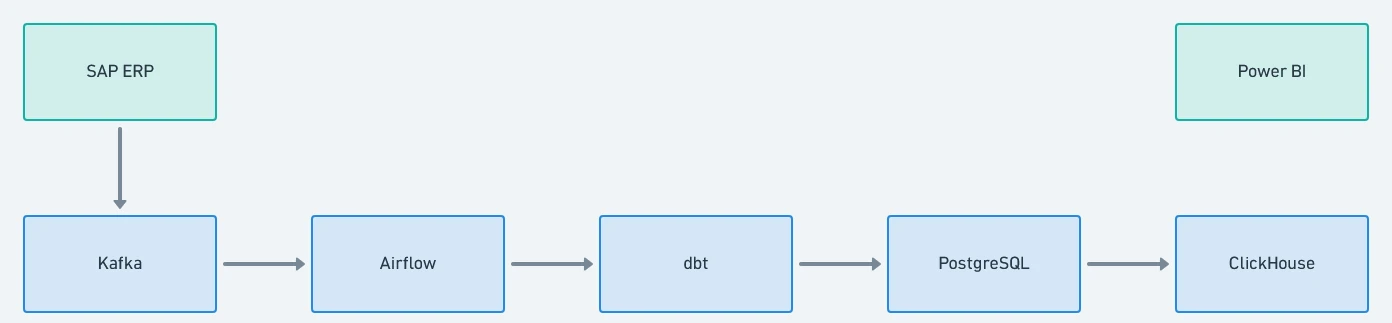
Example technology stack:
| Layer | Typical Choice |
|---|---|
| ERP | SAP |
| CRM | Salesforce |
| Workflow | Camunda (open source) |
| API Gateway | Kong (OSS or Enterprise) |
| Streaming | Apache Kafka |
| Database | PostgreSQL |
| Data Warehouse | Snowflake, BigQuery, or PostgreSQL depending on scale |
| ETL | Apache Airflow |
| Transformation | dbt |
| Monitoring | Prometheus + Grafana |
| Logging | OpenSearch or Elasticsearch |
| Kubernetes | Upstream Kubernetes or managed distributions |
This combination is the prevailing enterprise pattern because it balances flexibility, support, and cost.
Decision Framework
| Question | Open Source | Enterprise |
|---|---|---|
| Is downtime acceptable? | Yes | No |
| Is engineering strong? | Yes | Optional |
| Need vendor SLA? | No | Yes |
| Heavy compliance? | Limited effort | Strong built-in capabilities |
| Budget limited? | Yes | No |
| Extreme customization? | Excellent | Often constrained |
| Need guaranteed support? | Community or paid OSS support | Vendor support |
| Internal maintenance acceptable? | Yes | Less required |
Tips
- Many global companies run extensive open source infrastructure alongside enterprise applications.
- Enterprise software optimizes for governance, support, contractual accountability, and integrated capabilities.
- Open source often excels in innovation, flexibility, performance, and avoidance of vendor lock-in.
- For open source, licensing may be free, organizations still incur costs for: staff, infrastructure, monitoring, security, upgrades, maintenance, training, support.
- Decisions should be based on Total Cost of Ownership (TCO) rather than license cost alone.
- Use enterprise software for business-critical systems where vendor support, compliance, and contractual SLAs are essential (ERP, CRM, IAM, MDM, governance platforms).
- Use open source for platform infrastructure, developer tooling, data engineering, observability, and cloud-native components (Kubernetes, PostgreSQL, Kafka, Airflow, dbt, Prometheus, Grafana).’
- Integrate both through APIs, event streaming, and standardized governance.
- Evaluate technology decisions using business impact, operational risk, compliance requirements, staffing capability, and TCO, not licensing cost alone.